1° Sección: Contribuciones teórico-metodológicas en la investigación
de arte rupestre: la obligación de pensar y crear.
VI
Simposio Internacional de Arte Rupestre Jujuy 2003
1° Sección:
Contribuciones teórico-metodológicas
en la investigación
de arte
rupestre: la obligación de pensar y crear.
Post-Congress Revised Version
Léo DUBAL
dubal @ archaeometry.org
Resumén:
"Adornos y Máscaras" podrían haber sido el
resultado de la primera
actividad inteligente,
marcando la diferencia entre la humanidad y las otras
especies.
"Seducir o dar miedo" fue la estrategia del homo sapiens para
sobrevivir,
en su doble confrontación con sus aliados y con el mundo
animal.
Se discuten las evidencias de que el hombre ha tenido
únicamente un carácter
social,
con una personalidad individual inexistente.
Se pone de relieve con un particular énfasis el papel de los
"grafemas
icónicas"
en el carácter
estereotipado de las representaciones teri-antropomórficas.
Las estatuas-menhir, mudas y sordas, podrían estar
sugiriendo que el concepto
de la
personalidad individual surgió al mismo tiempo que la
sacralización de la
palabra y
la invención de la escritura abstracta y linear.
"Adornos
y máscaras", i.e.: Ornaments and masks might have
been the outcome
of
the first intelligent activity differentiating mankind from
other species.
Indeed, just the intention to decorate oneself might be unique enough
to characterize our
specie.
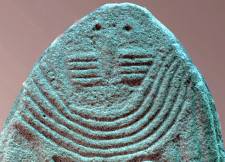
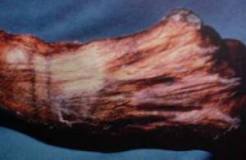
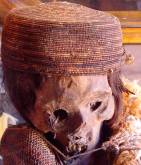
Repetitive motives such as parallel
lines, as scarification & necklace
on the Eneolithic statue-menhir of St Sernin
(F) see http://www.archaeometry.org/fenaille.htm
or on the tattooing on the left wrist of
Chalcolithic 5'300 years old mummy of ötzi
(click),
or the scarification on the forehead of Rosalia,
one of the set of
3 mummies
found
by J. Torres Aparicio in Inca Cueva 4 and which another one,
Chulina (click),
has been
dated to be 700 years older as
ötzi.
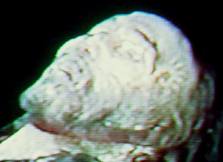
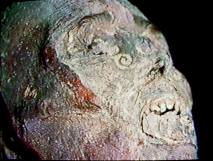
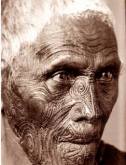
or the ornamental spirals on
the Taklamakan mummies, 2'500 years
old, revealed in the TV Film of Olivier Horn,
or the "pictorial
surgery" on this New Zeeland Maori face.
"To seduce or frighten" appears like the survival
strategy of homo
sapiens,
in his confrontation with his social partners and the animal
world.
It looks as if this new paradigm, i.e. seduce or frighten,
has taken the place of the former "attract or repel"
behaviour.
Archaeological remains suggest that the social role had
to be exhibited,
as if the individuation had not yet taken place
!
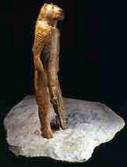
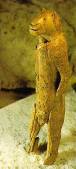
The 30'000 years old, mammoths ivory statuettes found in Germany (the
left one last
year)
with lioness head.. and unclear sex... might be a metaphor of the
appropriation
of
the protective power of the lioness.
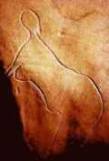
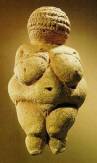
The 25'000 years old "First Lady", see
http://www.archaeometry.org/venus.htm
discovered in year 2000, in the Cussac' cave (F),
is
faceless (as her sisters in the neighbour cave of
Pech-Merle) .
Only her social role, her nurturing role is
depicted, as for the Venus of Willendorf.
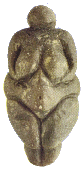
The Neolithic steatite statuette found in 2003 in La Marmotta on the
Lake of Bracciano
underlines the continuity of the nurturing role through at
least 18'000 years.
But not only female are faceless.
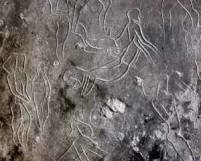
The mating
males (click)
in the Mesolithic cave of
Addaura (I) are faceless too.
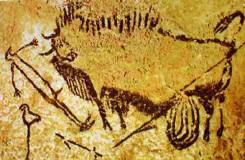
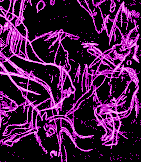
In the
Palaeolithic cave of Lascaux (France),
the face of the hunter of is hidden under a mask representing
a bird head,
while in the Trois-Frères cave,
the mask represents a head of an horned animal.
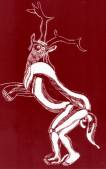
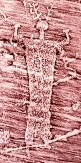
Still
in the Trois-Frères cave, the 18'000
years old mask figure with stag’s antlers and unclear sex,
might
be ,
like for the mask of the lioness, a metaphor of the
appropriation of
the stag’s power.
The
continuity of this branching horns mask through at
least 12'000 years,
is illustrated by the so-called Cernunnos in Valcamonica
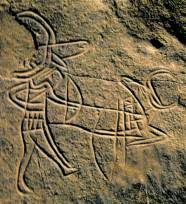

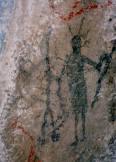
while those
Libyan archers are
hidden under a mask representing of a bovine head, too.
Such horned masks are
quite common, e.g. the Iron Age "Diavolo" of Valcamonica (Italy),
or the Chichillape guanaco hunter of
Quelcatani (Peru), with his two balls
"Bolladoras"
(while in the 9000
years old paintings in the Cueva de
los Manos, only one ball is depicted).
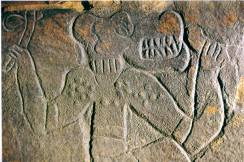
Here, instead of carrying a
mask depicting the head of an horned animal, this hunter
in Messak (Lybia)
carries a remarkable dog's head masks.
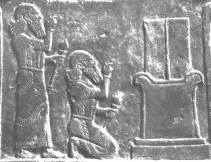
While here, on the very first
cartoon,
the Assyrian King Tukulti-Ninurta I (around year 1230 BCE)
stands and kneels
pointing with his finger toward a sitting God carrying the
mask of the
invisibility.
The depiction of a transparent mask is only possible, in our opinion,
in a culture having
reached the
ability to narratize, as coined by the psychologist
Julian Jaynes.
This mimetic anonymity of the social role is a kind of mask,
which,
to be operative, has to be recognizable at first glance.
In Rock Art, taken in its broad sense, this effect is sometimes achieved
through
"stereotyped graphical elements", or iconical
graphemes.
Iconical graphemes represent something on their own,
but that this something has no link with the
composed picture.
This process of substituting "one thing by another"
is an extraordinary
step toward abstraction.
Let us now look at some iconical graphemes
(click) of particular interest.
The Bovine's head grapheme
A
fine example of the use of this iconical grapheme is
the engraving of the so-called chief of tribe, in Mount Bego
(F).
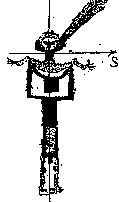
The bovine head grapheme appears here five times: for the face, the
neck, the
chest, the belly and the sex !
The v-shape Grapheme
It has been used to sketch
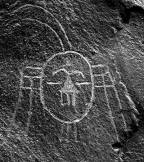
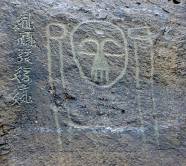
the
face of masks, in the Northern China site
of Helanshan http://www.archaeometry.org/helan.htm.
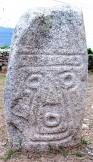
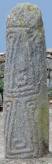
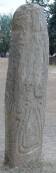
Some similarities might be found with Tafi's statues menhir in
Tucuman.
On one of them, this iconical grapheme appears four times, twice on
each face.
The presence of a mouth might testify for Narratization Age statues.
This grapheme,
but highly stylised,
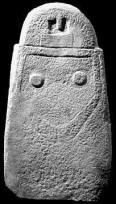
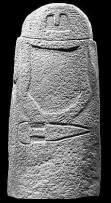
has been used to sketch the mute face of those Ligurian statue
menhirs of
Portovecchio.
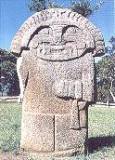
It is interesting to compare the minimalist version of this
grapheme
with the "complementary" one used on the San Agustin's statues.
The presence of the
mouth indicates, here again, a more recent facture.
The Owl's head grapheme
The iconical grapheme of the face of an owl
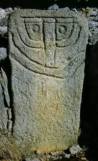
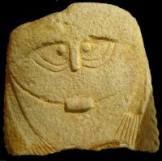
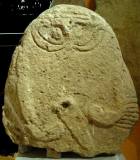
has been used on languedocian statues-menhir.
The Lotus flower grapheme
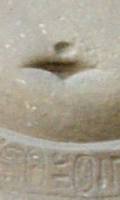
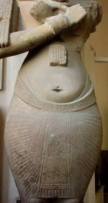
According to our findings, Pharaoh
Akhenaten, of the
18th dynasty, reigned from -1341 to -1324,
(while dates claimed on Internet for beginning of his 17 years long
reign encompass 30
years !).
Akhenaten is the first monarch who dared "to throw the mask
away",
and to exhibit his hermaphrodite figure.
Despite this naturalism, it is symbolically significant that the navel
of the
proto-patriarch
is disguised as a lotus flower...
But Akhenaten provides further clues of what lies behind
the mask.
He is
acknowledged for having launched two major socio-cultural revolutions:
1) the cult of a unique, faceless, abstract God
& abstract linear
writing.
According to our calculations, see http://www.archaeometry.org/nefertiti.htm
the introduction of
Akhenaten's solar cult
might
possibly have its "motivation"
in the occurrence,
on -1337.05.14
of a total solar eclipse between Thebes (E32.6°/N25.7°)
and Memphis,
i.e.: over Tell el Amarna, where his new capital will be erected.
2) the second
revolution is the introduction of abstract linear writing.
Significantly, scribes were ordered to use this writing for
the edict
forbidding images of the God Aten.
The link between those two revolutions has something to do
with our brain,
with the fact that abstract linear writing induces an unexpected
dominance
of the left hemisphere over the right hemisphere.
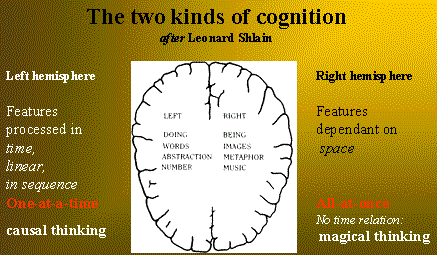
The
neuro-surgeon Leonard Shlain points out
(click) that
while the "old" right brain is in charge of all-at-once
nonverbal perception,
( and, I would say, without time
relation, the only way of
thinking is magical...)
the "new" left brain
is in charge of one-at-a-time
verbal perception, or at least 90% of it.
(And I would say, with the perception of
time, the way of thinking
can cope with causality)
The Hand grapheme
After the invention of the
alphabet, the increasing audacity
of
the engravers produced more unexpected iconical
graphemes.
As illustrated by this stele of Carthage, see
http://www.archaeometry.org/tanit.htm
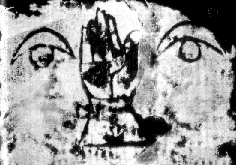
even a hand can represent a nose,
and the couple "moon crescent + solar disc" can represent eyes.
The Goddess Tanit grapheme
We
found that even Goddess Tanit's
sign
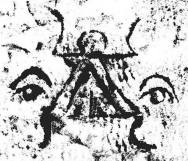
has been used as an iconical grapheme
http://www.archaeometry.org/grafemas.htm
to suggest a nose.
Let us point out that the Punic Goddess is faceless just as has
been,
one thousand years earlier, the Egyptian God Aten .
With the Gods trusted to carry the mask of social anonymity,
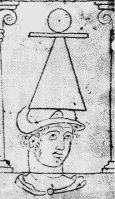
Time
has come for the homo individualis to unveil his
delicate face....
2009/10/31/11:14