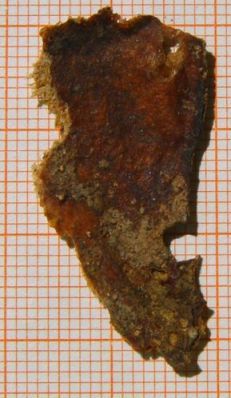
The sample of left temporal skin on millimetric paper (Photo: L. Dubal)
This sample was been carefully collected at the Museo J. TORRES APARICIO
in Humahuaca (Prov. Jujuy, Argentina), on the "Cabeza J.T.A.-240"
Léo
DUBAL &
Monique LARREY
Virtual Laboratory for Archaeometry
contact
A well preserved naturally
mummified paleoamerican head
has been found in 1936 with two other mummies
at La
Cueva de las Momias,
level 1A,
(misleadingly named Inca Cueva IV due to its proximity to
the Camino de los Incas)
at
3680 m.o.s.l., in the Quebrada of Chulin (Prov.of
Jujuy, Argentina)
by Justiniano
TORRES APARICIO, MD and folkmusic composer.
His "Clavelito blanco" is interpreted by
Thomas LIPAN
at url https://www.archaeometry.org/lipan.mp3
(188ko) .
A
sample of temporal skin from the head of Chulina
has been radiocarbon dated at the AMS Radiocarbon Laboratory
of the Federal Polytechnic Institute in Zürich.
The resulting calibrated
age of Chulina is 6'080
±
100 years (within 82% probability).
Compared with Ötzi (the paleoalpine mummy
found in Ötztal),
the age of this paleoandean head is 5'260 ± 50
years BP,
i.e., older by 724 ± 53 years BP.
The Cave of the Mummies has
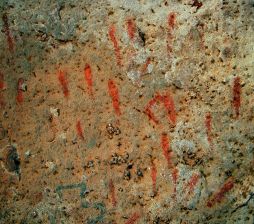
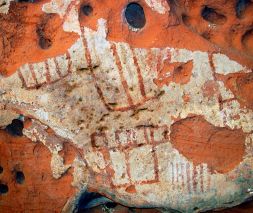
been decorated prior to sheltering the mummies.
Those results have been presented at the XVth World Congress
UISPP 2006, Lisbon, see Proceed. Session C04, Vol 37, pp.111-114
The three
mummies found by J.
TORRES APARICIO
were desiccated naturally, and therefore
suitable for radiocarbon
dating.
(let us remind here that radiocarbon dating of embalmed
Egyptians mummies is meaningless).
For this
study, was available a piece of temporal
skin of about 3 cm2
area and of a
weight of 120 mg.
The sample of left temporal skin on millimetric
paper (Photo: L. Dubal)
This sample was been carefully collected at
the Museo J. TORRES APARICIO
in Humahuaca (Prov. Jujuy,
Argentina), on the "Cabeza J.T.A.-240"
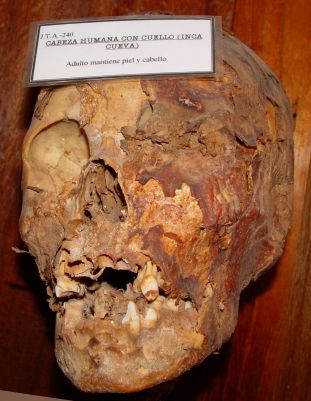
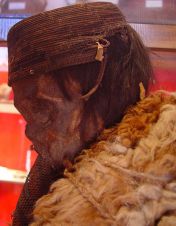
The naturally mummified human
head labelled
J.T.A.-240
in the Museum TORRES APARICIO (Photo: L. Dubal)
Thanks to
the highly appreciated support of
George BONANI & Irka HAJDAS
from the AMS Radiocarbon Laboratory of the Federal
Polytechnic Institute in Zürich,
the
skin sample
of JTA-240,
after having been thoroughly degreased and washed from
contaminants,
has
been submitted to the standard ETH 14C-AMS
dating method,
(which by the way has been applied
for
Ötzi
)
and results released on July,
8th, 2005 as
ETH-30630.
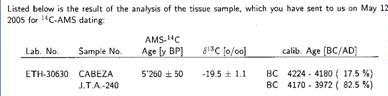
The δ13C
= -19.5 ± 1.1 °/°°
which is what one could expect for human skin.
The 14C-AMS Age is 5'260
± 50 y BP
The calibrated age is BCE 4170 - 3972 with 82.5%
probability
(while the age range BCE 4224 - 4180 has 17.5% probability).
Let us note
that earlier,
in 1986, Alicia FERNANDEZ DISTEL let perform
the radiodating of a sample of a wood container
found at level 1A, just next to the three mummies
gave 5'200
± 110 y BP.
In 1995, another radiodating (by
Beta Analytic in Miami) of a piece of wood,
gave 5'340 ±
70
y BP.
MORE...
The initial
name of the site: Inca
Cueva # 4,
is
inappropriate as it has only been occupied by palaeoamericans
between 10
and 4 thousands years Before Common Era.
We renamed it "La Cueva de las Momias"
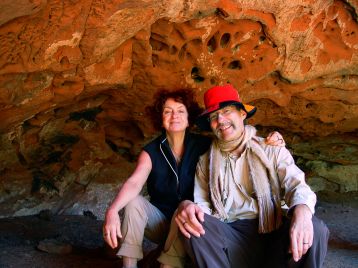
The authors, March
22nd 2005, at la
Cueva de los Momias,
on the spot where, in 1936, J. Torres
Aparicio exhumed
the mummies (Chulina,
Chulinita & Rosalia). (Photo:
P. Carentini)
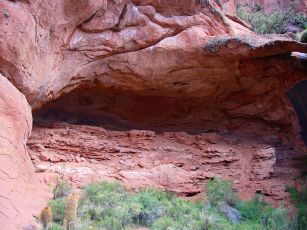
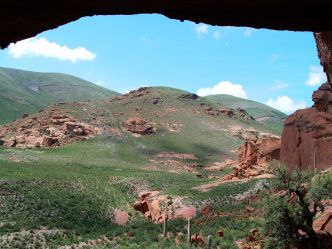
Look at La
Cueva de las Momias
Looking out from La
Cueva de las Momias
The GPS
coordinates of La
Cueva de las Momias is
:
S23°00’22.6” /
W65°28’05.1” 3680 mosl,
in the Quebrada
de Chulin, 2 h walk off Rio Grande.
La
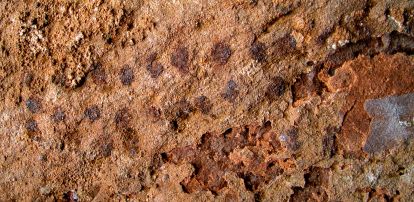
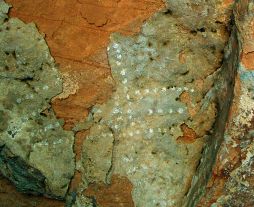
Cueva de las Momias is decorated with painted
patterns
with dots and strokes.
At
Humahuaca (Prov. Jujuy, Argentina), the collection
of late
Justiniano TORRES APARICIO,
was transformed into the Museo
J. TORRES APARICIO
In addition to the
mummified head of Chulina,
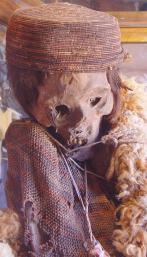
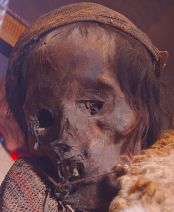
the Museum present two complete mummies,
in particular the one the inventor named Rosalia:
This
mummy is the naturally
dessicated remains
of a woman, 17
to 20 years old.
The fez of Rosalia is of a remarkable
finishing.
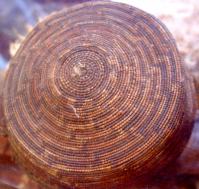
as well as her manta (105cm x 63 cm) in net.
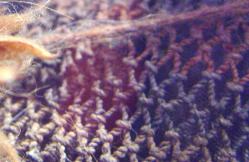
As no
logbook of the excavations has been found so far,
radiodating of samples of the fez
and manta,
would provide helpful data....
The last
mummy is the one of a
child, we named Chulinita.
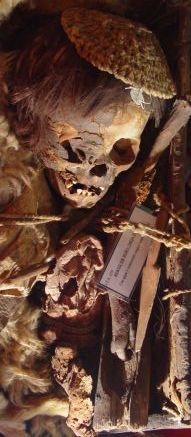
The
radiodating of the skin of Chulina in 2005
comforts the wood samples radiodatings of 1986 and 1995,
to promote Rosalia & Chulinita
for the title of the world oldest natural mummies.
Ötzi
died 5'235 ± 120 calibrated-years,
while Rosalia & Chulinita
lived in all likelihood 6'000 calibrated-years ago.
The undisturbed state of
the paintings of the Cave of the Mummies
implies that this RockArt
is at
least 6000
years old.
Acknowledgments:
We would like to thank here Mrs.
Alicia TORRES,
the owner and director of the Museo TORRES,
in Humahuaca (Jujuy, Argentina)
who authorized this study, and
Ms. Candelaria TORRES
APARICIO, the
grand daughter of Dr. J. TORRES
APARICIO
to
have lately express her interest in our results.
See
also the two communications :
XVth
UISPP Congress 2006
Global RockArt 2009
Click
here for the
Spanish version
Chulina
Click here for
the French version http:s//www.archaeometry.org/momie.htm