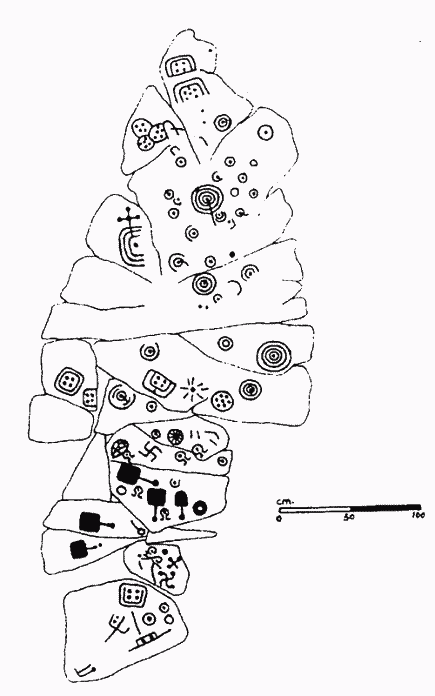
Some Iberian Concentric Circles
These engravings belong to the so called Galician-Portuguese Rock Art typical of the period at the end of the 3rd and the beginning of the 2nd millenium BC. In the NW of the Iberian Peninsula the "language" of the engravings is different if the rocks are vertical or parallel to the ground. In the vertical case, the motives are weapons, men riding horses, hunting scenes, while in the horizontal case, the motives are usually symbols like circles, cup marks, spirals, labyrinths, swastikas, etc. Those last motives are usually related with prehistorical religions and cults.
1.
Concentric circles at "Portela da Laxe"
(Viascon, Pontevedra, SP)
This rock surface, parallel to the ground, presents very
interesting engravings. The
concentric circles are difficult to interpret:: Are they astronomical
signs, altars, maps,
or what else ? Surely they do have a symbolic and religious meaning,
but as they appear
all over the world, in different cultures, their meaning might change,
e.g.: for the Hiwi
indians of Venezuela the circle represents the perfection while in case
of Fig. 4, the
circles may depict the shield of a warrior.
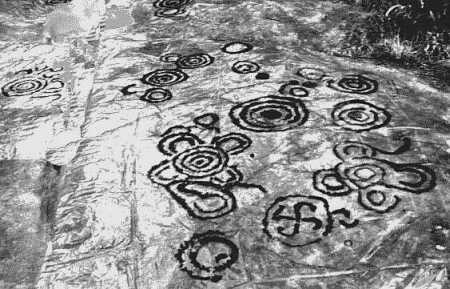
2. "Lage
dos Sinais" (The Rock
of the Signs), at "Barcelo"
(P) / Recording on
transparent foil
This rock depicts some examples of concentric circles inside
concentric
"UU". As suggested by Umberto Sansoni, those engravings were probably
made by
priests (or by artists guided by priests). Note:
A hyperlink to the paper
presented at IRAC 98 on this rock will be soon available.
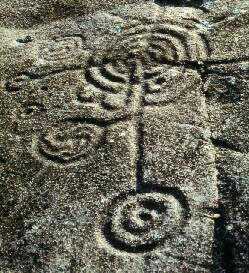
3. Concentric
circles at "Las Sombriñas"
(Pontevedra, Galicia, SP).
In this engraving, one can see a central large spiral from
where depart several lines
terminated by concentric circles with cup-marks inside. There is also a
swastika
surrounded by a circle (located in the middle of
the left-hand side),
similar to the one at Lage dos Sinais (see Fig. 2).
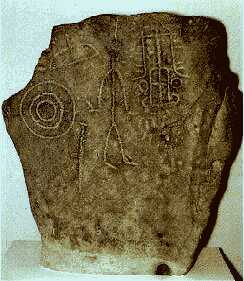
4. Stele with
Bronze age concentric circles (Archaeological
Museum, Sevilla, SP)
On this stele, one can recognize five motives: i)
a schematic representation of
a dead warrior /
ii) a sword / iii) a bow and arrow.
/ iv) a war charriot /
v) a shield, i.e. the concentric circles.
Such an interpretation is dictated by the context: the
sword, the bow & arrow and
the warrior.
Related link: click here