Torreblanca (Spain)
Drawing: Temple / Raynard
Dating Rock Art with
Solar Eclipses ?
Léo Dubal* & Serge
Koutchmy**
*) virtual laboratory for
archaeometry (vla) /
dubal @
archaeometry.org
**) Institut d'Astrophysique de Paris (IAP-CNRS)
/ koutchmy @ iap.fr
Abstract
We review several aspect of the human perception of solar eclipses,
total & annular, in ancient & pre-historical Art,
in China & other places .
Several candidates for representation of solar eclipses are compared
with the various actual appearances of this natural phenomenon.
Finally, attempts of dating such Rock Art, with engraved drawings
representing an eclipsed Sun, are presented. We discuss errors
resulting from the use of methods based on celestial mechanics for
dating pre-historical solar eclipses.
Introduction
For an odd-looking
piece of Rock Art engraving, in order to identify it, as a depiction of
a solar eclipse, and,
to date it, by scanning all the retro-predicted candidates,
a kind of qualified guessing appears
as a promising method.
Qualified guessing
means, here, to rely on :
I. A data
set of well documented naked eyes observations of
solar eclipses
II. An appropriate retro-prediction
model :
i) to comfort ancient records of solar eclipses,
ii) to provide a compatibility criterion to select candidates.
Some examples of lithic engravings possibly depicting a solar eclipse will be discussed.
I. Naked eyes
observations
a)
Total solar eclipses
As everyone should know, the observation of the sun with
naked eyes might induce very severe ophthalmologic problems
(though, the amount of light of the eclipsed sun, during totality, is
no more than the one of the full moon). In fact, we do not
know how many people have lost their vision (totally or only partially)
in the past.
During totality, bright stars
are becoming visible. While naked eyes observation of a total
solar eclipse is straightforward, equivalent photographic
imaging requests radial filtering or the processing of a composite out of the shots taken with varying
exposures. Christian
Viladrich (Institut d'Astrophysique de Paris)
built such a computer assisted mosaic out
of 8 shots he took on 26. Febr. 1998 of the eclipse over the
Guadeloupe Island, which can be downloaded
(590 Ko). On this amazing picture, the
lunar disk, lighted by earthshine, has
been enhanced and the
magnitude of the stars is indicated.
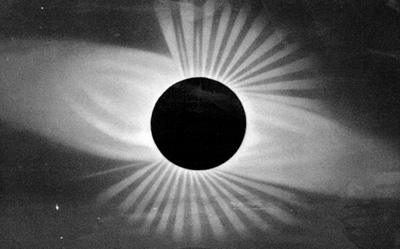
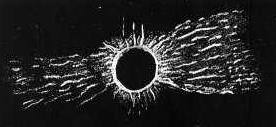
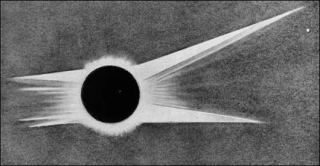
In favourable conditions, as one of us (S. K.) experienced in Nejapa (Mexico) during the total solar eclipse of March 7th, 1970, the structure of the corona can be observed with naked eyes, up to a distance from the centre of 6 solar radii. Various reports, old engravings, recent sketches and photographic pictures, all testify for the unsurpassed dynamical range of naked eyes observations. E.g.:
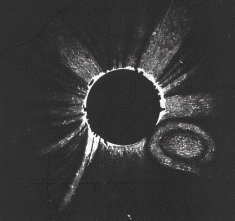
1860,
July 18, at 15:13
Torreblanca (Spain)
Drawing: Temple / Raynard
According to J. Eddy, this
is the 1st record of a CME (Coronal
Mass Ejection).
_______________________________________________
1878, July 29, at 16:40
Creston (Wy. /
USA)
Drawing: E.L. Trouvelot
_______________________________________________
1900, May 28, at 16:18
(barely total, M=1.003)
Algiers (Algeria)
Drawings : Andrew C.D. Crommelin & E.W. Maunder
_______________________________________________
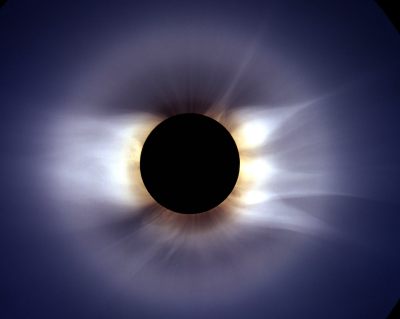
1973, June 11, at 11:31
near
Moussoro (Chad)
Photo: Serge Koutchmy
One of us (SK) did
visually observe the corona during the 7 minutes long totality of this
eclipse.
He observed the two simultaneous small chromospheric bright features (near
both the 2nd and 3rd contact)
and the coronal structures, i.e.: the so-called helmet
streamers and the long streamers with open stalk.
The length of those streamers estimated visually
exceeded l.5 solar diameter,
i.e., as long as, or even longer than, the length seen on the
photographic picture.
_______________________________________________
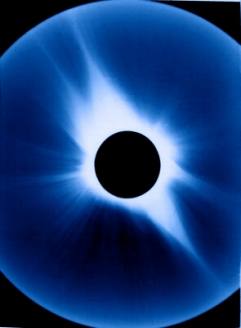
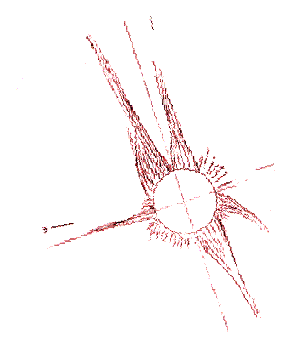
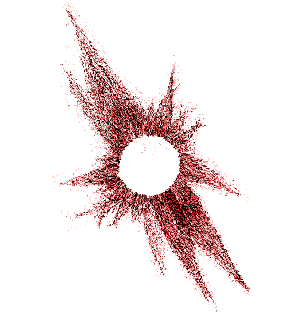
1991, July
11th,
at 10:30
Baja California (Mexico)
Photo: Boris Filippov / Sketches: Hiroyoshi Tanabe & Haruko
Shibayama
B. Filippov testified that
his photo represents adequately what he
saw with naked eyes,
up to a distance from the sun of at least one solar diameter.
H. Tanabe & H. Shibayama, with 4 other contributors, took part
in an experiment "Sketches of the Solar Corona" in
real time.
Those 3 pictures illustrate well the differences between photographic
and eye-brain system recordings.
_______________________________________________
b)
Annular solar eclipses
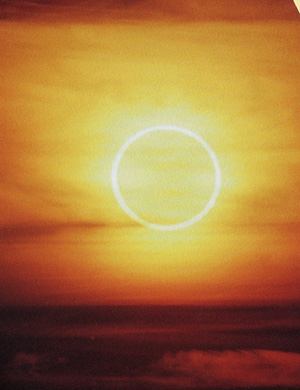
During annular eclipses,
with over 96% shadowing of the sun, the blinding danger is somewhat
reduced
(particularly if only a reflected image on a water surface is looked
at), compared with full direct sunlight.
Annular eclipses do not allow the observation of the solar corona, but
such events remain impressive.
1994,
May 10th, at 18:58
near
Casablanca (Morocco)
Photo: René Verseau
_______________________________________________
2. Retro-prediction model
The retro-prediction of ancient
solar eclipses is bound with the understanding of the slowing down of
the Secular Rotation Rate of the Earth,
and has been reviewed in-depth by F. R. Stephenson, in Historical
Eclipses and Earth's Rotation, Cambridge Univ. Press 1997 .
Several Computerised Canons of
Eclipses are available, but only some allow the user to "fine tune" the
so-called D
T,
the difference between Universal Time based on Earth rotation and
Atomic Time. We used here the
"freeware":
EMAPWIN of Shinobu Takesako.
The procedure is as follow:
One selects the observation site of his choice by giving in its
longitude and latitude, and a starting date.
Then, on the built-in map, one scans the trajectories of all eclipses
and selects the relevant ones
(in this process, the programme assumes a certain deceleration of the
Earth).
Now, if one suppose that, at a given date, the eclipse has been maximum
at this location,
one should try to optimised the D T. One is left
with the following data :
date and time / magnitude and duration / D T
In order to test a retro-projection model, it is
primordial to have access to a large
reference data set of historically reliable solar
eclipses.
Computerised Canon of Eclipses, such as EMAPWIN, list all eclipses
which occurred in the past, but
how to evaluate the reliability of the record of the
observation of an ancient eclipse ?
The specialised literature and the web are spammed
with "records" of eclipses,
suggested by insufficiently qualified linguists (e.g.: the so-called
Ugarit eclipse),
or, as we will see, eclipses whose argued sites of observation
contradict the analysis of the reference data set.
In our opinion, this reliable reference data set can only be
(a critical selection of the eclipses reported in) the
Chinese Annals.
A most important calibration point for retro-projection models
has been suggested by L. V. Morrison & F. R. Stephenson, in ORION,
2001, p. 304,
as the eclipse over Chang'an (Xian), on March 4th, -180.
Their result is D T
= 3.4 h.
Let us note that, even if one knows (or guesses) from a written record
the site of observation,
the time span to be considered for the occurrence of an eclipse might
be large.
It can reach several centuries,
e.g.: one Shang turtle bone oracle, excavated in Xiaotun near Anyang
(Henan) in the nineteen-forties,
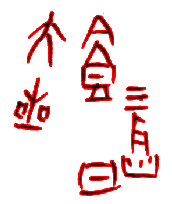
has been discussed in 1989 by Xu
Zhentao, K.K. Yau & F. Richard Stephenson, in Archaeoastronomy
#14, S71.
A total solar eclipse has been guessed to be depicted here :
"three flames (of the corona),
eat the sun, big stars (visible)",
but contradictory interpretations cannot be discarded.
In modern Chinese, one would write, according to Pang & al. :

san1
xian4
shi2 ri4
da4
xing2
where the
semi-homophone, in pinyin:
xian4
, in english : trap,
is (supposedly) substituted to flame,
in Chinese :

yan4
At
the time, the dating fork was given as the whole period of the Shang
dynasty,
i.e.: from -1'600 to -1'050.
In the hypothesis of the description of an eclipse,
this leaves room to several candidates !
In order to document the slowing
down of the Earth's Secular Rotation Rate,
Kevin D. Pang, K.K. Yau & H.H. Chou analysed Chinese records
depicting solar eclipses,
in GeoResearch Forum 3-4, 1998, pp. 459-488.
In
particular, Pang & al. believe to have
succeeded
to date precisely the "3-flames-eclipse" as the very long one
(6 minutes), which occurred on 5 June –1301.
Unfortunately, in such a case, a control dating measurement by AMS (14C
/ 13C / 12C ratio) of,
properly extracted, organic carbon of the collagen of this very
tortoise-shell (serial # 13.0.13510).
is not possible,
due to the custom to expose the shell to fire and consequently destroy
the datable collagen
Pang
& al. realised that the set of D T for all ancient Chinese eclipses could be
described by
D T = c . t2
where they assumed
c = D
T . [(1800-year)/100]-2
c being
expressed in units of "seconds per century, per century" [ s
. cy-2].
Below are listed five ancient eclipses supposedly reported in Chinese
Annals, and the check we made with EMAPWIN.
| Site Co-ordinates |
Date (UT) t2= (1800-year/100) 2[cy2] |
UT LMT |
Magnitude Length |
c
[s.cy-2] |
| Sanmiao E114.0/N28.0 |
24 Sept –1911 1377 cy2 |
10:36
18:12 |
.984
(annular alt. sun=0) 1m 33s |
32.0 44040 s |
| Xiaotun E114.35/N36.4 |
5 June –1301 962 cy2 |
03:08
10:48 |
1.04 6m 19s |
27.4 26360 s |
| Zheng
1 E109.8/N34.5 |
21 Apr –898 728 cy2 |
22:16 05:35 |
0.962 (annular alt. sun=0) |
28.3 20630 s |
| Chang'an
(Xian) E108.9/N34.3 |
4 March –180 392 cy2 |
07:42 14:57 |
1.021,
3m 6s |
31.3 12260 s |
| Zheng
2 E109.8/N34.5 |
4 Apr +368 205 cy2 |
22:27 05:46 |
0.993
(annular alt. sun=0) |
29.0 5960 s |
Pang's finding is that :
27.5 < c < 32.5 [ s . cy -2 ]
Those results are summarised in the following graph:
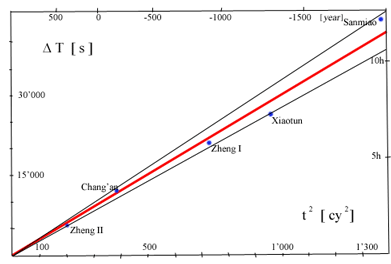
D T [s]
vs. t2 [cy2] :
(in red D
T = 30 . t2,
in black D T = 27.5 t2
& D T = 32.5 t2
)
Reference solar eclipses /
observation site(year):
Zheng2(382) / Chang'an(-180) / Zheng1(-898) / Xiaotun(-1301) /
Sanmiao(-1911)
In other words, Pang succeeded to formulate a criterion
to check the plausibility of ancient eclipses at a given observation
site.
Nevertheless a +/- 8% represent pretty broad limits.
Applications
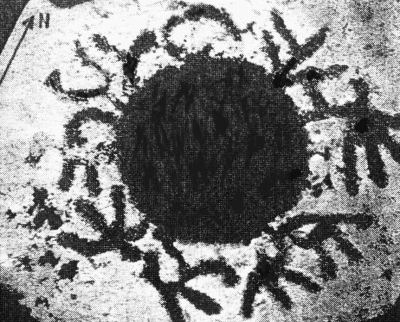
1. A Swiss astronomer, W. Brunner suggested that the rock engravings in the County of Tanum (in Sweden) were depicting the same solar eclipse, The one of 23. October -1067. One could argue that the bronze age style of the engravings is compatible with an earlier date. From the design style, we would well see in those engravings the depiction of an annular eclipse, i.e. the one of 12 March -1361, though there are other eclipses compatible with Pang's criterion.
| Tanum
County E11.33/N58.71 Aspeberget, |
15 Sept -1381 1012 cy2 |
10:22 11:07 |
.974
(annular ) 3m 17s |
31.3 31675 s |
| 12 Mar -1361 999 cy2 |
08:14 8:59 |
.963 (annular ) 4m 04s |
30.4 30404 s |
|
| 14 Mar -1231 919 cy2 |
12:55 13:41 |
1.024 3m 19s |
28.5 26134 s |
|
| 18 Jul -1229 917 cy2 |
08:04 8:50 |
1.01 3m |
31.3 28890 s |
|
| W.Brunner's selection 23 Oct -1067 822 cy2 |
11:47 12:32 |
1.013 1m 53s |
30.3 24907 s |
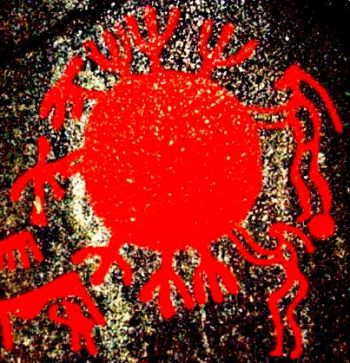
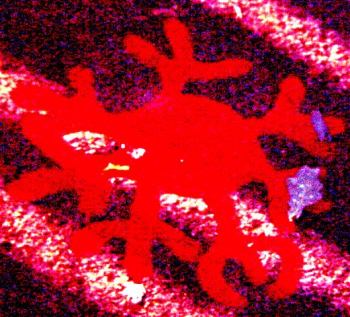
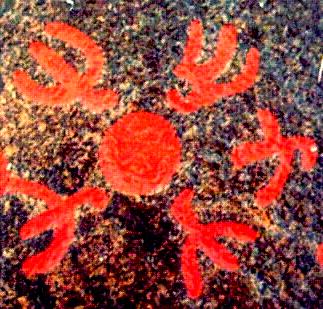
Aspeberget
Fossum
2. The Swiss astronomer, W. Brunner suggested that the rock engravings in Carshenna (Switzerland) and Coren del Valento in Valcamonica (Italy) represent the total solar eclipse of 13 July -884. This eclipse does only marginally satisfy Pang's criterion.
| Carshenna E9.48/N46.68 |
W.Brunner's selection 13 Jul -884 720 cy2 |
10:18 10:56 |
1.023 5m 06s |
32.7 !! 23562 s |
| Coren
del Valento E10.35/N46.03 |
10:19 11:01 |
1.00 0m 30s |
In addition, it contradicts
the archaeological context. The Bronze age style of those engravings
call for a quite earlier date.
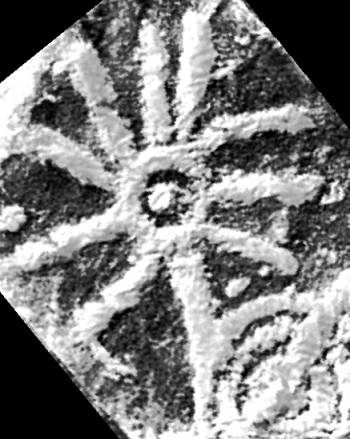
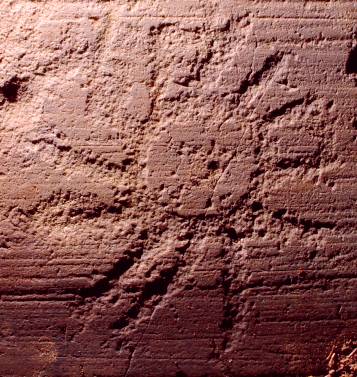
Carshenna / Valcamonica
Our best alternate candidate is 15 November -1430.
| Carshenna E9.48/N46.68 |
Archaeological selection 15 Nov -1430 1044 cy2 |
13:21 13:54 |
1.017 2m 33s |
30.4 31708 s |
| Coren
del Valento E10.35/N46.03 |
11:47 12:32 |
1.011 2m 21s |
Conclusion:
Those preliminary results for dating Rock Art & lithic engravings with solar eclipses confirm our expectations in the potential of this "reverse method", where, instead of trying to date an eclipse in order to measure the slowing down of Earth rotation, one uses the values of this rate, what we call the "Pang's criterion", to establish the plausibility of the date of a solar eclipse.
Note : Since
this early attempt, one of us (LD) has
shown see http://www.archaeometry.org/titanic.pdf
that all reliable solar eclipse records
of World Annals
are compatible with a simple parabolic Model of the slowing down of
Earth's spin
.
Acknowledgement: One of us (LD) would like to thank here Dr
Xu Zhentao for his kind help, and Dr K. Pang for his most useful
comments on his work.
10/10/09 17:27